Download Afghan Civilian Police Program Free
Statement attributable to the Spokesman for the Secretary-General on Afghanistan Security Council press statement on terrorist attacks in Kabul More.Missing. DOD Obligations and Expenditures of Funds Provided. For the training of the Afghan National Police. The audit showed that the DOS Civilian Police Program.
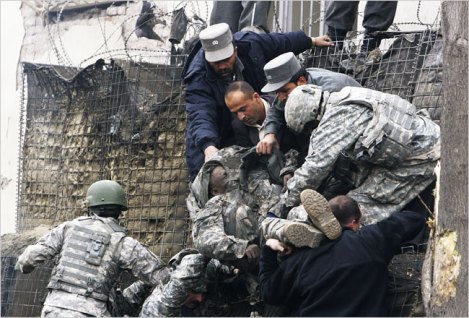
Armed-forces personnel are trained to 'engage and destroy,' peace officers 'to protect and to serve.' Expecting young recruits to play both roles is expecting too much. Reuters The soldiers' proverb that 'it is better to be judged by 12 than carried by six' has recently gained new currency among American troops in Afghanistan. For combat soldiers, its meaning is clear: when in doubt, shoot first and ask questions later. While civilians may find this violent mindset shocking, it's important to recognize that we train our soldiers to, in the words of the U.S.
Army's soldier's creed, 'engage and destroy the enemies of the United States of America in close combat.' From its very inception, the Unites States military has defended American interests by threatening and, if required, committing violence.
In basic training, drill instructors bellow the question, 'What makes the green grass grow?' , to which new recruits respond by screaming, 'Blood -- bright red blood!' And stabbing a dummy in the guts with a bayonet. This is how we train our warriors and how we have done it for over 100 years. We train our troops to kill, equip them with the world's most effective weapons, and send them to war. Yet in many instances, our leaders then ask these trained warriors to serve as peace officers, a job that involves entirely different expectations and holds them to a different standard.
There are special subunits within the military whose members are trained to play both cop and commando, but the very nature of name 'special' demonstrates that this is not normal training. Admittedly, 'police actions' are nothing new to U.S. Armed Forces.
President Harry Truman used that term to describe the Korean War. In Vietnam, the most notorious of American policing actions, generals (or presidents) declined to bomb certain targets for fear of provoking intervention from China and the USSR. But in Korea and Vietnam, these 'police actions' were typically at the strategic level. In Afghanistan, the troops patrolling the streets are expected to both fight as warriors and serve as peace officers at the tactical level. The blurring of this distinction is not without consequences, as young men and women struggle to protect the same people they've, in some instances, been ordered to fight.
Take the example of Private First Class Edward Richmond, Jr., who in 2004 was providing security in a small village outside Kirkuk, Iraq, while his unit searched the village for high-level insurgents. Richmond's squad was tasked with providing security while the rest of the unit cleared the village (a cordon search mission). Richmond's squad leader, Sergeant Jeffrey Waruch, instructed the squad on its rules of engagement: 'Shoot any males fleeing the village, but check with [the squad leader] if possible before firing.' When the operation began at daybreak, American soldiers heard gunshots and screaming in both Arabic and English coming from the security line. Richmond noticed a man leaving the city near his position.
Remembering his initial order, Richmond requested permission to engage the target. Waruch later testified that 'Edward asked if he could shoot the man.' Waruch ordered Richmond not to shoot the fleeing man and instead headed towards him, instructing Richmond to assist him in detaining the fleeing Iraqi. As the two soldiers approached the Iraqi, he became agitated, and Waruch ordered him to put his arms up. As Waruch went to search the Iraqi, he directed Richmond to stand guard with his rifle ready.
Waruch quickly patted the man down, looking for weapons and when he tried to pull his wrist down to handcuff him, the man resisted. Waruch told Richmond to point his weapon at the man and told him to 'shoot him if he moves.' At that point, the man stopped resisting and Waruch was able to cuff him.
As the two soldiers headed back to their perimeter with their prisoner, the Iraqi man tripped and stumbled into Waruch. Richmond shot one round, hitting the detainee.
He later stated that the detainee had jumped at Waruch. The Iraqi died as a third soldier came to the scene. Without knowing exactly what had happened, the third soldier looked at Richmond and said 'you are f---ked.' Richmond had been in Iraq for less than three weeks.
At court martial, Richmond was acquitted of unpremeditated murder, but convicted of voluntary manslaughter, sentenced to three years, demoted to private, and given a dishonorable discharge. This example demonstrates what happens when soldiers and marines are drilled to be combat killers and then asked to demonstrate the restraint of police officers. Even more frustrating for his family is that Richmond was not even shown the same grace we allow to law enforcement officers in the United States when their good-faith use of lethal force turns out to be a mistake.
According to the official standard currently followed by the FBI, the use of lethal force is deemed a 'good shoot' when an 'agent has a reasonable belief that the subject of such force poses an imminent danger of death or serious physical injury to the agent or another person' -- even if that 'reasonable belief' turns out to be wrong. It is simply unreasonable to hold soldiers serving in a war zone to a higher policing standard than that to which we hold actual police officers serving U.S. In all fairness, the military has devoted considerable effort and resources to training troops on policing skills before they deploy, and it has tried to emphasize a culture of restraint among the ranks -- most prominent was the recent talk of a 'Courageous Restraint Medal.' But the idea was ultimately quashed when some in the military and media decried the mixed message it would give to troops in harm's way. ('You have the authority to kill because you are in danger, but please don't.' ) The change in training and the attempt to transform the culture is likely to have little effect when drill sergeants still walk the firing lines screaming 'One shot, one kill' -- hardly an invitation to the kind of restraint in the field that we are now asking of our men and women in uniform. Moreover, the police and military cultures are supposed to be vastly different (see ).
Soldiers use deadly force when confronting the enemy, and their weapons are their main tools in completing this objective. Police officers, by contrast, are required to try to accomplish their missions without using weapons -- they are trained to exercise deadly force only as a last resort.
The military uses violence as a means to an end, while a police officer draws and shoots only to protect himself/herself or others from violence. There's also a reason that different populations are chosen to serve in each force. Police officers typically must be over 21 and many local police departments require at least an AA degree, recognizing that confronting complex situations on the street requires a certain level of maturity.
In the military, by contrast, many soldiers are only 18 or 19 -- and in a platoon, even the lieutenant (the platoon leader/commander) may only be in his or her early 20s. In wartime, our soldiers operate in an extremely chaotic and confused environment -- every civilian is a potential enemy, every window a possible sniper's nest. The police in U.S. Cities (usually) confront a more comprehensible and structured situation -- no more than a few suspects, bystanders who are generally assumed to be friendly or neutral.
At war, chaos and lack of structure make it even more difficult for our soldiers to be effective policemen. Our military has done, and is continuing to do, an amazing job. Iraq and Afghanistan presented ever-shifting situations and our soldiers adapted too many changes on the fly. But our political and military leadership must more carefully examine the additional responsibilities that come with these new environments and understand the unprecedented pressures they're placing on our men and women in uniform. The views expressed by Rizer are entirely his own, and he does not speak for the Department of Justice or the U.S. The protests that have rattled Iran this weekend are in many ways an echo of the near past. In the summer of 2009, took to the streets to protest the reelection of President Mahmoud Ahmadinejad, whose rhetoric and policies had isolated their country for four years.
The opposition believed his reelection victory was fraudulent. They chanted slogans demanding a recount of the votes. Others denounced the regime and its highest authority, Supreme Leader Ayatollah Khamenei. Hardliners and security forces confronted the crowds with anti-riot gear and harsh condemnation, often labeling them agents of foreign powers. It was a huge moment and seemed, at the time, to portend an irreversible shift in geopolitics.
Seven years and three days ago, the House of Representatives grumblingly voted to approve the Senate’s version of the Affordable Care Act. Democrats in the House were displeased by many of the changes introduced by Senate Democrats.
But in the interval after Senate passage, the Republicans had gained a 41st seat in the Senate. Any further tinkering with the law could trigger a Republican filibuster. Rather than lose the whole thing, the House swallowed hard and accepted a bill that liberals regarded as a giveaway to insurance companies and other interest groups. The finished law proceeded to President Obama for signature on March 23, 2010. A few minutes after the House vote, I wrote a short blog post for the website I edited in those days. The site had been founded early in 2009 to argue for a more modern and more moderate form of Republicanism.
The timing could not have been worse. At precisely the moment we were urging the GOP to march in one direction, the great mass of conservatives and Republicans had turned on the double in the other, toward an ever more wild and even paranoid extremism. Those were the days of Glenn Beck’s 5 o’clock Fox News conspiracy rants, of Sarah Palin’s “death panels,” of Orly Taitz and her fellow Birthers, of Tea Party rallies at which men openly brandished assault rifles. Laura Kiesel was only 6 years old when she became a parent to her infant brother.
At home, his crib was placed directly next to her bed, so that when he cried at night, she was the one to pick him up and sing him back to sleep. She says she was also in charge of changing his diapers and making sure he was fed every day.
For the majority of her early childhood, she remembers, she tended to his needs while her own mother was in the depths of heroin addiction. From as early as she can remember, Kiesel says she had to take care of herself —preparing her own meals, clothing herself, and keeping herself entertained. At school, she remembers becoming a morose and withdrawn child whose hair was often dirty and unkempt. Protest movements in the Middle East face enormous repressive hurdles and rarely have happy endings.
Even when protesters “succeed” in toppling an autocrat, they’ve rarely succeeded in ending autocracy. In Iran, the obstacles to success are daunting. Whereas most Middle Eastern countries are ruled by secular autocrats focused on repressing primarily Islamist opposition, Iran is an Islamist autocracy focused on repressing secular opposition. This dynamic—unarmed, unorganized, leaderless citizens seeking economic dignity and pluralism, versus a heavily armed, organized, rapacious ruling theocracy that espouses martyrdom—is not a recipe for success. And yet, against this inauspicious backdrop, Iran’s mushrooming anti-government protests—although so far much smaller in scale than the country’s 2009 uprising—have been unprecedented in their geographic scope and intensity. They began December 28 in Mashhad, a Shiite pilgrimage city often considered a regime stronghold, with protesters slogans like “leave Syria alone, think about us.” They soon spread to, Iran’s holiest city, where protesters expressed nostalgia for Reza Shah, the 20th-century modernizing autocrat who ruthlessly repressed the clergy.
They continued in provincial towns, with thousands chanting, “we don’t want an Islamic Republic” in, “death to the revolutionary guards” in, and “death to the dictator” in. They’ve since spread to Tehran, and hundreds have been, the BBC reported, citing Iranian officials. Taz Ahmed is 38, single, Muslim, and Bengali.
She describes herself as spiritual, but not particularly religious. When she was growing up, her immigrant parents hoped she would marry an I.T. Worker they found for her in Oklahoma. “I’m like, ‘I don’t even know who this person is, what do you even know about him?’” Ahmed recently told me.
“They’re like, ‘You’re asking too many questions. You don’t need to know this much information.’” Like other U.S. Muslims of her generation, Ahmed has spent a lifetime toggling between various aspects of her identity. She got to prom night by promising her mother she’d go with a gay guy. She swapped marriage in her 20s for a master’s degree.
She even followed a band as it toured the country—a coming-of-age story straight out of Hollywood, except that it was a Muslim punk group called the Kominas. As Sean Hannity hyped a conspiracy theory about the murder of a Democratic National Committee staffer last week, touting it with the zeal of a true believer without citing evidence that justified that belief, the combative Fox News host declared himself under fire and in need of backup. Lashing out at what he called “” and “,” he took particular umbrage at a campaign by the progressive group Media Matters for America to pressure his advertisers, an effort he called. “They hope to get me fired,” he. “Rush, O'Reilly, Beck, Imus, & now me.” He may succeed in rallying his fans. But Hannity’s angry claims elide the fact that the progressives at Media Matters have sought the scalps of conservatives like him for more than a decade.
The Media Matters website has 3,488 items tagged “Hannity” dating back to 2006. Its latest push isn’t the reason his position is as precarious as it has ever been (nor did Media Matters stop Bill O’Reilly, who was sunk by multiple “” allegations, or Rush Limbaugh, who is still on the air). This past year, reporters on The Atlantic’s science, technology, and health desks worked tirelessly, writing hundreds of stories. Each of those stories is packed with facts that surprised us, delighted us, and in some cases, unsettled us. Instead of picking our favorite stories, we decided to round up a small selection of the most astonishing things we learned in 2017.
We hope you enjoy them as much as we did, and we hope you’ll be back for more in 2018: • The record for the longest top spin is over 51 minutes. Probably won’t make it past 60 seconds.
• Flamingos have, which makes them more stable on one leg than on two. • If your home furnace emits some methane pollution on the last day of 2017, it’ll almost certainly leave the atmosphere by 2030—but it could still be raising global sea levels. • By analyzing enough Facebook likes, an algorithm can predict someone’s personality. • There are cliff-hanging nests in northern Greenland that. Researchers read the layers of bird poop in the nests like tree rings. • • Six-month-old babies basic words like mouth and nose. They even know that concepts like mouth and nose are more related than nose and bottle.
• Most common eastern North American tree species. • In 2016, Waymo’s virtual cars logged in simulated versions of California, Texas, and Arizona. • America’s emergency 9-1-1 calling infrastructure that there are some parts you can’t even replace anymore when they break. • The transmitters on the Voyager spacecraft have as much power as refrigerator light bulbs, but they from billions of miles away.
• By one estimate, one-third of Americans currently in their early 20s. • Donald Trump has a long and on the early web.
• Somewhere around 10,000 U.S. Companies—including the majority of the Fortune 500— based on the Myers-Briggs test. • Humans have inadvertently created, formed when radio communications from the ground interact with high-energy particles in space. This bubble is capable of shielding the planet from potentially dangerous space weather like solar flares. • Climate-change-linked heat waves. • China from 2011 to 2013 than America did during the entire 20th century. • A lay minister and math Ph.D.
Was the best checkers player in the world for 40 years, spawning a to solve the entire game to prove the man could be beaten. • There is, where the Nansen Ice Shelf meets the sea. • On Facebook, Russian trolls on May 21, 2016, bringing Muslim and anti-Muslim Americans into real-world conflict at an Islamic center in Houston. • Boxer crabs like boxing gloves, and if they lose one of these allies, they can make another by ripping the remaining one in half and cloning it. • may be essentially useless to travelers, but to airlines they are valuable space for advertising.
• Scientists can figure out the storm tracks of 250-year-old winter squalls by reading a map. • On islands, deer are occasionally licking small animals, like cats and foxes—possibly because the ocean breeze makes everything salty. • People complained of an “” in 1896. • Languages worldwide have for describing warm colors than cool colors. • Turkeys are as they were in 1960, and most of that change is genetic.
• Two Chinese organizations of the global Bitcoin-mining operations—and by now, they might control more. If they collaborate (or collude), the blockchain technology that supposedly secures Bitcoin could be compromised. Physicians prescribe of the necessary amount of opioids. The Sims 3 Complete Collection All Sp Ep 2014 Repack Mr Dj Games. • Physicists discovered in the Great Pyramid of Giza using cosmic rays. • Daily and seasonal temperature variations, even if the temperature is always above freezing, by expanding and contracting rocks until they crack.
• The eight counties with the largest since 1980 are all in the state of Kentucky. • The has less to do with the rise of smartwatches and more to do with the rising cost of gold, the decline of the British pound, and a crackdown on Chinese corruption. • Spider silk is self-strengthening; it can from the insects it touches to make itself stronger. • Intelligence doesn’t make someone more likely to change their mind. People with higher IQs are better at crafting arguments to support a position—but. • Among the strangest and yet least-questioned design choices of internet services is that. • Steven Gundry, who has contributed to Goop, believes Mercola.com, a prominent anti-vaccine site, is a site that gives “very useful health advice.” • At many pumpkin- and squash-growing competitions, entries are: Any specimen that’s at least 80 percent orange is a pumpkin, and everything else is a squash.
• Only of all U.S. Google employees are black, and only 4 percent are Hispanic. In tech-oriented positions, the numbers fall to 1 percent and 3 percent, respectively. • The weight of the huge amount of water Hurricane Harvey dumped on Texas 2 centimeters. • Russian scientists plan to re-wild the Arctic with.
• The NASA spacecraft orbiting Jupiter can never take the same picture of the gas planet because the clouds of its atmosphere are, swirling into new shapes and patterns. • During sex, male cabbage white butterflies inject females with packets of nutrients. The females chew their way into these with a, and genitals that double as a souped-up stomach. • If all people want from apps is to see new stuff scroll onto the screen, if that content is real or fake. • Cardiac stents are extremely expensive and popular, and yet they don’t appear to have outside of acute heart attacks.
• Animal-tracking technology is just showing off at this point: Researchers can glue tiny barcodes to the backs of carpenter ants in a lab and scan them repeatedly to. • One recommendation from a happiness expert is to build a “,” which is a place in your house that you pass a lot where you put pictures that trigger pleasant memories, or diplomas or awards that remind you of accomplishments. • Some ancient rulers, including Alexander the Great, after an eclipse, as a kind of sacrificial hedge. • A colon-cancer gene found in Utah can be traced back to a single from the 1840s.
• In November and December 2016, the Butterball Turkey Talk-Line to ask for turkey-cooking advice. That’s an average of over 1,500 calls per day.
• In the United States as a whole, of the land is hardscape. In cities, up to 40 percent is impervious. • Half of murdered women by their romantic partners. • Among the Agta hunter-gatherers of the Philippines, more than hunting, fishing, or basically any other skill.
• The familiar metal tokens in the board game Monopoly didn’t originally come with the game, to save costs. Popular were only added to the box later. • Thanks to the internet, American parents are for their children, trying to keep them from fading into the noise of Google. The median boy’s name in 2015 (Luca) was given to one out of every 782 babies, whereas the median boy’s name in 1955 (Edward) was given to one out of every 100 babies.
Download Logo Maker For Pc there. • America’s five most valuable companies are between Northern California and Seattle. • President Kennedy secretly had Addison’s disease, a hormonal disorder, which he with injections of amphetamines and steroids from Max Jacobson, a doctor whose nickname was “Dr. Feelgood.” • Some of the most distant stars in the Milky Way were actually “” from a nearby galaxy as the two passed near each other.
• Hummingbirds drink in an unexpected way: Their when they hit nectar, and close on the way out to grab some of the sweet liquid. • New York City has genetically distinct. • The search for Malaysia Airlines Flight 370 created one of the ever. • People who can’t find opioids are taking an over-the-counter diarrhea drug.
Some are consuming as many as. • It used to take to make one pound of insulin. (Insulin is now made by genetically engineered microbes.) • Astronauts on the International Space Station the yummy aromas of hot meals like we can on Earth because heat dissipates in all different directions in microgravity. • “Sex addiction” in any official capacity, and it’s actually a deeply problematic concept that risks absolving men of agency in sexual violence. • The peculiar (and previously unidentified) laughter that was recorded for the Golden Record was—well, we won’t spoil it for you until you. • The oldest rocks on Earth, which are, have signs of life in them, which suggests that the planet was biological from its very infancy.
• Fire ants form during floods. But you can break up the rafts with dish soap. • Until this year, no one knew about a whole elaborate system of. • People are worse storytellers when their listeners by saying things like “uh-huh” and “mm-hmm.” • China’s new radio telescope is large enough to hold on the planet. • Scientists calculated that if everyone in the United States, we could still get around halfway to President Obama’s 2020 climate goals. • The reason that dentistry is a separate discipline from medicine can be traced back to —when two self-trained dentists asked the University of Maryland at Baltimore if they could add dental training to the curriculum at the college of medicine.
The physicians said no. • Naked mole rats can survive for at all. If you’re not taking vitamin B12, forget about having energy. Oz Show has, “End your energy crisis with Vitamin B12.” The nice thing about sublingual pills is “you don’t need a doctor, you don’t need a prescription.” And don’t get me started on metabolism. If you want to “supercharge your metabolism and energy levels,” Amazon can deliver you a tall bottle of B12 supplements by the end of the day. Your metabolic processes will be the envy of the neighborhood.
On something?” “Yes—B12!”) These are the sort of vague marketing claims that have propelled the cobalt-based compounds sold as B12 into American hearts and minds and blood in ever-growing quantities. They are extrapolations from the fact that B12 deficiency causes anemia, and correcting that deficiency will alleviate symptoms of fatigue and weakness. But as the National Institutes of Health notes, “Vitamin B12 supplementation appears to have no beneficial effect on performance in the absence of a nutritional deficit.”. Much of 2017 was consumed with untangling the political mess that was 2016 and Russia’s role in it. Much of what we learned came from American journalists, who brought us revelation after revelation about how the Kremlin meddled in the presidential election.
Through these reporters’ domestic sources—in the White House, Congress, and the intelligence community—we learned how Russians aimed at sowing division; how Russian government agencies and; how Russians loosely affiliated with the Kremlin; and how the Kremlin the popular Kaspersky Labs anti-virus software into a spying tool. HEMET, California—Many cities across America are doing better today than they were before the recession. This is not one of them. A decade after the start of the Great Recession, it struggles with pervasive crime and poverty. “We’re still recovering—we were really hit hard on all levels,” Linda Krupa, the mayor of Hemet, told me.
A fifth of the population lives below the poverty line, up from 13 percent in 2005. Hemet is not alone in its troubles. A released this year by the Economic Innovation Group, a research group started by Silicon Valley entrepreneurs, found that one in six Americans lives in what the group calls “economically distressed communities” that are “increasingly alienated from the benefits of the modern economy.” Such communities have high shares of poverty, many housing vacancies, a large proportion of adults without a high-school diploma, high joblessness, and a lower median income than the rest of the state in which they are located. They also lost jobs and businesses between 2011 and 2015.